
How Do You Join the Peppol Network? The Three Things You Need
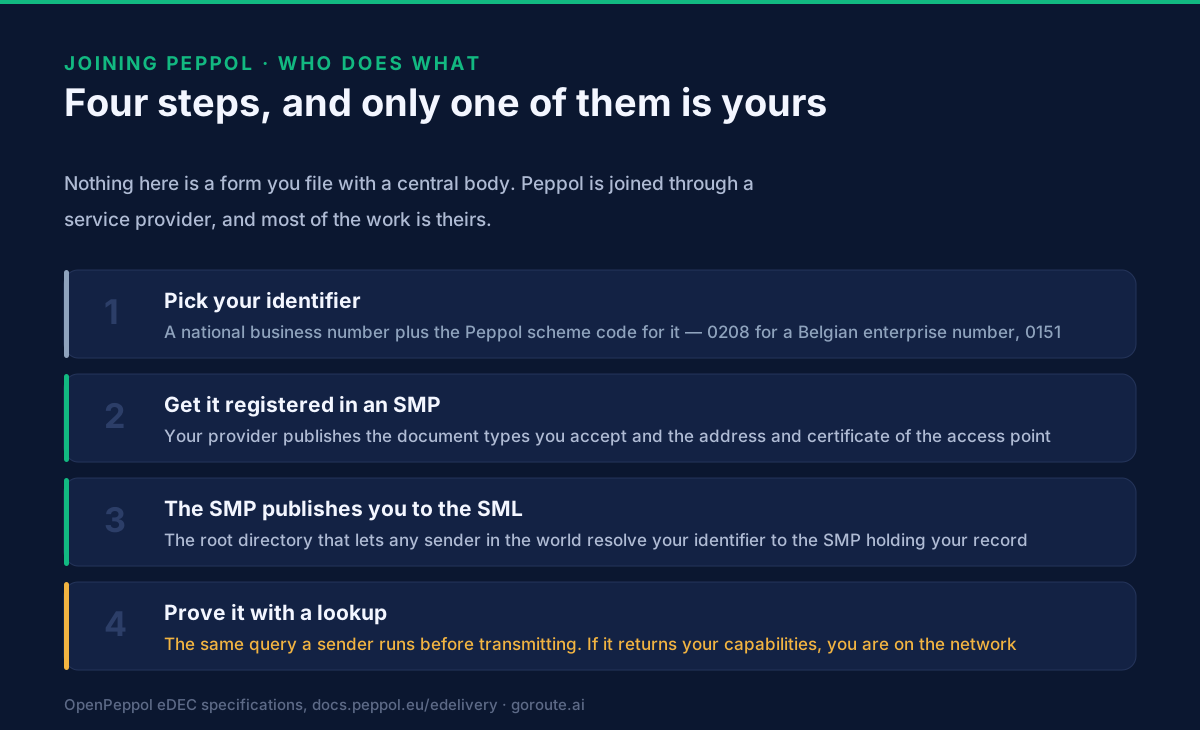
Joining Peppol needs three things: a participant identifier, a record in an SMP, and somebody to send and receive for you. Here is who does each step.

Joining Peppol takes three things: an identifier, a record in a registry, and somebody to send and receive for you. There is no central membership office and no form to file with OpenPeppol. You are on the network when a stranger's software can look up your business number and get back a list of the documents you accept and the address to send them to. Everything below is how that state is reached, and who does each part.
If e-invoicing itself is new, start with how e-invoicing works over Peppol. This article is about the joining, written from OpenPeppol's own published specifications and from the registrations we run.
What does "being on the Peppol network" actually mean?
It means one lookup succeeds.
Before an access point transmits anything, it asks the network two questions: who holds this recipient's record, and what will that recipient accept? If both questions answer, the document can be sent. If the first fails, the recipient does not exist as far as the network is concerned — however many contracts, portals or accounts they hold elsewhere.
So joining is not a status somebody grants you. It is a set of entries that either resolve or do not. That is why the last step in this article is a lookup rather than a confirmation email.
What is a Peppol participant identifier?
It is a scheme code and a value, written together as scheme:value.
The scheme code says which national or international register the number comes from; the value is your number in that register. OpenPeppol's Policy for use of Identifiers, version 4.4.0 of 6 February 2025, requires the scheme to be taken from the code list OpenPeppol maintains, and defines the meta-scheme every Peppol component uses as iso6523-actorid-upis.
Concrete examples, all from live registrations:
0208:0848934496— a Belgian enterprise number. It is OpenPeppol's own: the association is registered in Brussels under 0848.934.496, and that identifier resolves on the network today.0151:...— an Australian Business Number.0088:...— a Global Location Number, which is international rather than national.0002:...— a French SIRENE number.
Two rules catch people out. Identifier values are case-insensitive, so 0088:abc and 0088:ABc are the same participant, while 0088:abc and 0010:abc are different ones. And scheme codes marked "deprecated" in the code list must not be used for new registrations, because the agency that issued them is no longer active.
If you are Belgian, the enterprise-number question has its own answer: see why Belgium uses 0208 and what changed.
Who registers you, and what do they register?
Almost always your service provider — and what they register is not just your number.
An SMP entry carries your participant identifier, each document type you are willing to receive, the process each type belongs to, and the address and certificate of the access point that will accept it. That last part is why registration and access point cannot be fully separated: the registry has to name somewhere for documents to go.
You do not need to operate that access point. It can be your provider's, or your current provider's if you are keeping them. Operating your own requires Peppol accreditation and its own certificates, and for most businesses it is cost with no return.
There is one important exception to "your provider registers you". In some countries the tax authority operates the registry centrally. Oman is one: the taxpayer selects a provider on the Fawtara portal, the provider accepts, and then the Tax Authority itself creates the participant identifier and the service group in its own central registry, after which the provider publishes its receiving capabilities through the Authority's interface. Nobody sells you registration in that model, because the Authority performs it. If you are choosing a provider under a mandate like this, the question to ask is about the mandate, not about the registry — our guide to choosing an access point sets out what else to ask.
What is the difference between the SMP and the SML?
The SML says where to ask. The SMP gives the answer.
The Service Metadata Locator is the network's root directory. It resolves a participant identifier to the publisher holding that participant's record, and it does so through DNS: the identifier is lowercased, hashed with SHA-256, Base32-encoded, and used as a hostname under the SML zone. OpenPeppol's identifier policy gives the worked example — 0088:123abc in the zone edelivery.tech.ec.europa.eu. becomes Y7DZFXAF3D4CJZ4KCGRXTEC6TWVCGA4KY7ZWA5BOIF6MSWD4TDRQ.iso6523-actorid-upis.edelivery.tech.ec.europa.eu.
The Service Metadata Publisher is the record itself. Once DNS has pointed the sender at the right publisher, an ordinary HTTPS request returns your capabilities: your document types, and the endpoint and certificate to use.
Both are governed documents rather than conventions. The current Peppol Service Metadata Publishing specification is version 1.4.0 and the Service Metadata Locator specification is version 1.3.0, both valid from 1 November 2025, alongside the Peppol AS4 Profile version 2.0.3 that governs the transmission itself. They are listed, with their validity dates, on OpenPeppol's eDelivery specifications page.
The practical consequence for someone joining: there is nothing to do about the SML. Your SMP publishes to it as part of registering you. It matters only when something goes wrong, because a participant who resolves in the SML but fails at the SMP has a different problem from one who does not resolve at all.
How do you check whether a company is already on Peppol?
Run the lookup a sender would run.
Ask the network for the identifier and read what comes back. A registered participant returns a service group with its document types and receiving endpoint. An unregistered one returns a 404 — not a failure, but the network correctly reporting that nobody by that identifier is reachable.
This is worth doing before you register anything, for two reasons. Companies are sometimes registered already, by a provider engaged years ago or by a group parent. And it is the same check that tells you whether a customer who is asking for e-invoices can actually receive them. You can run it free, without an account, on our Peppol lookup.
What does it cost, and how long does it take?
The registration itself is minutes of work; what takes time is deciding who receives for you.
Our own registration service is $29 a month per organisation, covering up to 50 registered participants, with the traffic going to whichever access point you name rather than through us by default. If you already have a provider, you give us their AS4 endpoint address and public certificate — details every provider supplies routinely — and your documents keep going to them.
If you want to be registered, that is what /smp/ does: it collects your details, registers your identifiers in the SMP and the SML, and finishes with a live lookup proving you are discoverable. If instead you need someone to run a Service Metadata Publisher on your behalf as infrastructure — you are a platform or an access point operator with participants of your own — that is a different product, described on SMP-as-a-Service.
What this article does not tell you
Three things, deliberately.
Whether you are legally required to be on Peppol. That depends on your country and your size, and it changes. The 2026 e-invoicing mandates tracker carries the dates.
Which document types to register. Registering a type you cannot process is worse than not registering it, because senders will use it. Register what your system genuinely handles today, and add types as you build them.
How long the network takes to see a change. SMP records are read live, but caching exists at several layers and DNS has its own timings. Where a go-live date matters, register ahead of it rather than on it.
Frequently asked questions
- How do you join the Peppol network?
- You get a participant identifier, have it registered in a Service Metadata Publisher (SMP) together with the document types you accept, and have that registration published to the Service Metadata Locator (SML) so senders can find you. In practice a service provider does the second and third steps for you.
- What do I need before I can join Peppol?
- A business number that appears in the Peppol participant identifier code list — a Belgian enterprise number, a Dutch KvK number, an Australian Business Number and many others qualify — and a decision about which access point will send and receive on your behalf. That can be your own, or your provider's.
- Who registers me on the Peppol network?
- Normally your service provider. In some countries the tax authority runs the registry itself and creates your record centrally once you nominate a provider on its portal; Oman works this way. Nobody registers themselves directly with OpenPeppol.
- What is a Peppol participant identifier?
- A scheme code and a value, written as scheme:value — for example 0208:0848934496, which is OpenPeppol's own Belgian enterprise number. The scheme codes come from a code list OpenPeppol maintains, and the Policy for use of Identifiers version 4.4.0 requires every participant identifier to use one of them.
- What is the difference between the SMP and the SML?
- The SML is the root directory and the SMP is the record. The SML resolves your identifier to the SMP that holds your details, using a DNS name built from a hash of your identifier. The SMP then returns what you accept and where to send it. The SML says where to ask; the SMP gives the answer.
- Do I need my own access point to be on Peppol?
- No. You need one to be named against your registration, but it can belong to your provider. Running your own requires Peppol accreditation and its own certificates, which is a substantial undertaking and unnecessary for most businesses.
- How do I know it worked?
- Look yourself up. A registered identifier returns a service group listing your document types and the receiving endpoint; an unregistered one returns a 404, which is an answer rather than an error.
About Dr. Syed Raza
Dr. Syed Raza is an IT Enterprise Architect at ClayDesk LLC and leads the GoRoute platform. He works across Peppol Access Point and SMP infrastructure, PINT jurisdictions (Oman, AU/NZ, EU, JP, MY, SG), and national CTC regimes, translating regulatory detail into production-grade e-invoicing systems.
Building on Peppol?
GoRoute is a certified Peppol Access Point & SMP. Book a demo or read the docs to get started.